
“In the business world, the rear-view mirror is always clearer than the windshield.”
— Warren Buffett
For the past three years, investing in the Indian specialty chemical sector felt like a masterclass in market punishment. The multi-bagger darlings of the post-pandemic era—which could do no wrong when global supply chains fractured in 2021—faced an unrelenting, frozen downcycle. Valuations were slashed by 30% to 50%, margins collapsed under the weight of negative operating leverage, and retail investors fled the sector in droves.
Yet, as we move through 2026, the ground beneath the chemical industry is quietly shifting. The market is transitioning from structural despair to cyclical stabilization. To the untrained eye, the windshield still looks foggy, but the laws of the capital cycle tell us that the structural bottom is finally here.
1. The Anatomy of a Freeze: Recent Trends in Indian Chemicals
The “Specialty Chemical Winter” was not a failure of Indian engineering or corporate governance; it was a textbook example of the Bullwhip Effect.
In 2021 and 2022, global agrochemical and pharmaceutical giants panicked over pandemic lockdowns and over-ordered raw materials. Indian manufacturers responded by executing massive capital expenditure (Capex) programs at the absolute peak of the cycle.
By late 2023 and throughout 2024, the script flipped. Global buyers realized they were sitting on mountains of inventory. They stopped buying entirely to “destock,” causing demand for Indian exporters to evaporate overnight.
The Historical Precedent: We saw this exact same loop play out globally during the 2012–2015 chemical glut. Following the massive post-2008 Chinese stimulus, chemical capacity surged globally. When global macro demand cooled in 2014, corporate earnings crashed, leading to a long, grinding multi-year bottom before the massive structural rally of 2017.
2. The Capital Cycle: Mapping the Valuation Trough
Markets operate on a brutal truth: Stock prices are a leading indicator, while corporate earnings are a lagging indicator. If you wait for a company’s net profits to hit record highs before investing, you will likely miss the first 40% to 50% of the stock price recovery.
When a sector enters a cyclical trough, valuations undergo a massive “time-correction” and “price-correction.” High-growth companies that comfortably commanded Price-to-Earnings (P/E) multiples of 60x to 70x during the euphoria see their multiples compressed down to historic floors.
In mid-2026, we are seeing the classic signature of a cycle bottom: Volume growth is starting to precede value growth. While product prices remain suppressed due to international competition, the actual metric tonnes of chemicals shipped by top-tier Indian firms have begun ticking upward over the last two quarters—a clear signal that global inventory destocking has finally concluded.
3. The Giants at a Turning Point: PI Industries & Deepak Nitrite
To separate structural winners from cyclical value traps, an investor must look for two things: pricing power resilient enough to hold gross margins steady, and a balance sheet strong enough to survive the winter. Let’s look at how two industry titans are positioned in 2026.
PI Industries: The Coiled Spring
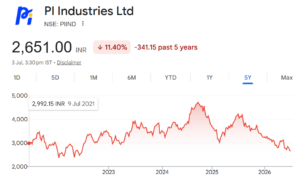
PI Industries, the undisputed king of the agrochemical Custom Synthesis and Manufacturing (CSM) export model, was hit hard by the downcycle. For the full fiscal year, the company saw a 16% drop in revenue and a 20% decline in net profit as global agri-input demand stalled. The stock plummeted nearly 40% from its peak of ~₹4,800 to an accumulation zone near ₹2,600.
-
The Valuation Compression: Historically, PI’s P/E has swung between a low of 26x and a high of 67x. Today, trading at ~30x trailing earnings, the market has completely priced in the earnings decline.
-
The Structural Turning Point: Despite a double-digit drop in volumes, PI’s gross margins expanded by over 500 basis points, holding firm at 58%. Furthermore, PI’s largest global client, Kumiai Chemical, recently upgraded its EBITDA guidance by a staggering 70.5%, signaling a sharp recovery in export orders for late 2026 and 2027.
Deepak Nitrite: The Fully Integrated Phenolics Leader
Deepak Nitrite is a phenomenal case study in structural resilience through forward integration. Over a 15-year horizon, it transformed from a commodity sodium nitrite producer into a dominant player across phenolics and advanced intermediates. In FY26, consolidated revenue stood at ₹7,947 crore and PAT came in at ₹551 crore. While the full-year figures felt the pinch of the global cycle, the recent Q4FY26 earnings printed a massive turnaround story.
-
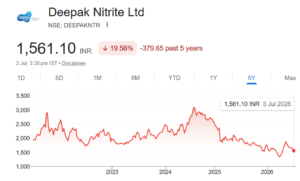
The Valuation Trough: Trading around ₹1,558, down significantly from its historical all-time highs above ₹3,000, the stock currently commands a P/E of ~38x. This sits comfortably within its multi-year support channel.
-
The Structural Turning Point: Q4FY26 showed a spectacular sequential turnaround—EBITDA surged 74% quarter-on-quarter to ₹383 crore, and PAT jumped 120% QoQ to ₹220 crore. This profitability spike was led by their dominant Phenolics segment (which commands >50% domestic market share in phenol and acetone).
-
The Mega-Capex Bet: Rather than retreating, Deepak Nitrite is executing a massive ₹11,000 crore to ₹11,500 crore capex pipeline between 2026 and 2028. This includes setting up India’s first fully integrated 165,000 MT per year Polycarbonate plant through its subsidiary, Deepak Chem Tech.
4. The Mechanics of the Flood: How Chinese Dumping Works
To understand when this winter will fully thaw, we must demystify how Chinese manufacturers are able to flood global markets with impossibly cheap chemicals.
What looks like irrational economic behavior to a private Indian firm is perfectly logical under China’s state-directed model, which relies on three distinct pillars:
-
The Fuel-to-Chemicals Pivot: As domestic electric vehicle (EV) adoption skyrocketed in China, local oil refiners faced a structural collapse in gasoline demand. To survive, they aggressively diverted crude oil derivatives into upstream petrochemicals and intermediate chemical manufacturing, creating a massive, unregulated domestic supply pipeline.
-
The Domestic Consumption Crisis: This capacity pipeline went live just as the Chinese real estate market hit a prolonged systemic slump. With domestic industries unable to absorb the chemical output, Chinese manufacturers chose to export the surplus at whatever price the global market would pay, rather than shatter factories and trigger mass layoffs.
-
State-Funded Cash Deficits: Many Chinese chemical producers are state-owned or heavily tied to provincial governments. Backed by state banks continually rolling over cheap debt, these companies can operate at negative margins for years because local governments prioritize employment figures and GDP targets over corporate return on equity (ROE).
5. The Verdict of History: What Makes the Dumping Stop?
The current oversupply feels permanent, but economic history proves that no nation can subsidize loss-making, capital-destroying factories indefinitely. Two powerful historical precedents show how this cycle inevitably ends.
Precedent 1: The 2016–2018 “Blue Sky” Chemical Crackdown
A decade ago, a hyper-fragmented, state-subsidized Chinese chemical sector flooded the world, crushing Indian chemical stock prices down to multi-year lows by 2015.
The turning point came in 2016. Driven by catastrophic urban pollution and immense banking sector stress from unprofitable loans, Beijing launched its Supply-Side Reforms. Central environmental inspectors swept through industrial provinces and permanently shut down tens of thousands of non-compliant chemical plants overnight.
The resulting global supply deficit triggered the golden era of Indian specialty chemicals. Compliant, well-capitalized Indian companies like Deepak Nitrite—which had spent years building high-quality infrastructure—saw their earnings explode, delivering 5x to 10x stock market returns between 2017 and 2021 to patient investors who bought the 2015 bottom.
Precedent 2: The 2014–2016 Global Steel Crisis
In 2014, a domestic real estate slowdown forced China to dump its excess steel capacity globally, dragging Indian steel majors to the brink of balance-sheet distress.
The dumping stopped due to two clear forces: Global Tariff Walls and Internal Consolidation. Governments worldwide erected immediate anti-dumping barriers (similar to the 105%+ anti-dumping duties the European Union and India are currently imposing on Chinese chemical imports in 2026).
Concurrently, Beijing stepped in to enforce an “anti-involution” policy—mandating the elimination of over 150 million metric tonnes of zombie steel capacity to save its domestic banking system. By late 2016, global steel prices staged a violent V-shaped recovery, leading to a historic re-rating of Indian metals.
The Turnaround
The specialty chemical sector is currently running through the final stages of a classic capital cycle template:
The crowd is always loudest when things are great and quietest when things are cheap. When PI Industries and Deepak Nitrite were trading at all-time highs with a cheery market consensus, they were structurally safe but valuation-wise highly dangerous.
Today, while the near-term quarterly headlines remain volatile, the extreme valuation premium has been thoroughly cleared out. For long-term investors, buying high-moat, debt-free market leaders during the freezing depths of a cyclical winter has historically been the safest way to capture asymmetric, market-beating returns when the spring finally arrives.