
AI came, AI saw, AI conquered. Over the last 12 months, the volume of capital pouring into Artificial Intelligence has shifted from a corporate tech race into one of the most massive physical capital-deployment booms in economic history.
To look past the media hype, we must examine the hard data across three distinct financial pillars:
1. Hyperscaler & Big Tech Capital Expenditure
The single largest driver of AI investment comes from tech giants—specifically Microsoft, Alphabet, Meta, and Amazon—building data centers, purchasing advanced GPUs, and locking down energy grids.
-
The Reality: Combined capital expenditure for these four “hyperscalers” is on track to reach an unprecedented $725 billion for the full year.
-
The Acceleration: This represents a 30% to 40% year-over-year increase. To put this into perspective, this infrastructure spend exceeds the total annual GDP of most sovereign nations.
2. Global Enterprise Procurement & Software Spending
Beyond infrastructure builders, regular enterprises are spending capital to integrate AI into daily corporate workflows.
-
The Scale: Gartner projects full-stack worldwide AI spending—spanning software, cybersecurity, model training, and consulting—to hit $2.59 trillion.
-
The Growth Driver: The fastest-moving segment has been AI agent software (autonomous workflows), which skyrocketed by over 130% to clear an $86 billion run-rate.
3. Venture Capital, Private Equity, and M&A
For early-stage startups and foundational model builders, capital formation has reached all-time highs.
-
The Numbers: The Stanford HAI Index indicates global private corporate AI investment surpassed $581 billion.
-
Geographical Divergence: The United States dominated, capturing $285.9 billion (nearly half the global pool) and significantly widening its lead over China and Europe.
The Takeaway for Investors
We are no longer dealing with a speculative software bubble. The data proves the AI trend is backed by trillions of dollars in physical infrastructure, creating massive structural winners in the semiconductor and power sectors.
For Indian retail investors, this has been a painful lesson. While the NIFTY has given no returns in last 2 years, the USA based NASDAQ has zoomed above 30%.
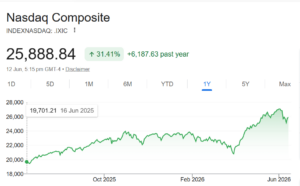
Portfolios heavily weighted in traditional sectors like consumption and automobiles have delivered NIL returns for the past two years, as the market continues to ignore them. The companies that had strong fundamentals and clean balance sheet have also suffered due to external factors beyond their control, like blocking of Hormuz or rapidly depreciating ruppee, thus forcing them them to eat into their reserves.
To navigate this wave, investors have two choices: build a portfolio highly exposed to AI and semiconductors, or build one completely agnostic to it. However, avoiding AI entirely is no longer viable. To generate long-term wealth, your portfolio must have direct or indirect exposure to this capital boom. The future returns will come from combining the basic principals of value investing. like debt free balance sheets, MARGIN OF SAFETY etc with new technology based businesses. But remember that to make money long term you have to face the agony of short term fluctuations.