
‘The best investors are dead investors’- Anonymous
While inactivity is not a virtue in ‘real world’, in the world of investing being lazy can make you rich. Why does laziness pays so much in the world? Because the power of compounding is unleashed ONLY in the long term.
Refer below chart where KEI industries share price have become 70X in the last decade. But it has been a roller coaster ride for investors. The stock has traded below its previous prices by 20% for more then 20 times in these 10 years.
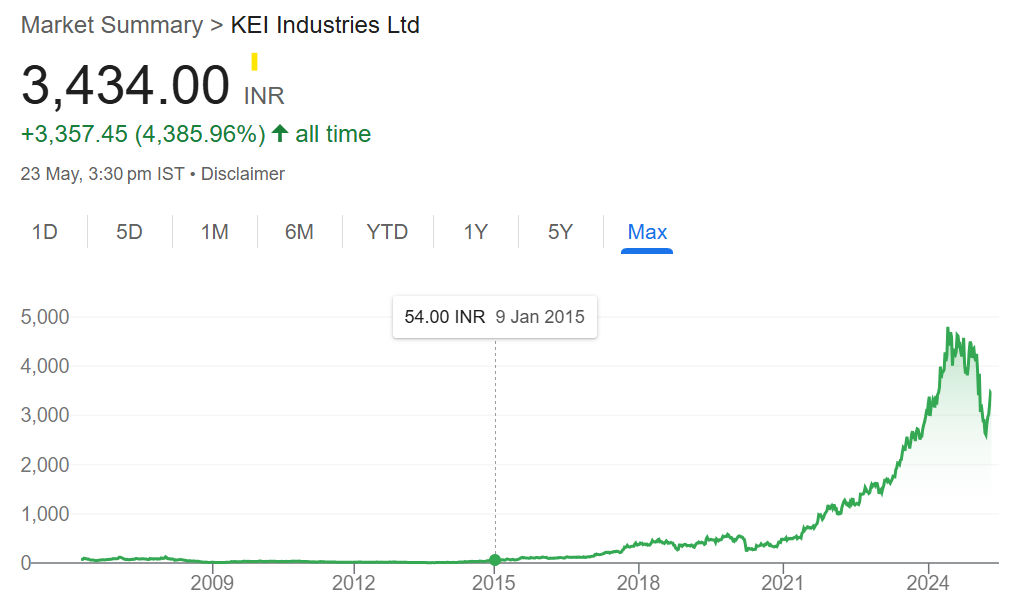
So what was needed to hold the stock of KEI for 10 years? Turns out the answer lies not in the world of finance but in the field of psychology. There are some human biases which can significantly alter your investment returns:
– Buying when the price is low: Many retail investors buy penny stocks or buy stocks just because they are cheap and trading at substantial discount. This approach is doomed for failure as it does not allow you to build conviction when making the purchase. Only when you have done a deep research and spend some time tracking the stock, you can build the conviction to buy. This conviction will give you the courage to hold the stock when the price fluctuates. Always write the reason for adding a stock to your portfolio and keep on returning back to the reason from time to time. This helps you to test your hypothesis and make correction going forward.
– Mistakes of commission: Many retail investors make the mistake of holding on to the losers/laggards in the portfolio but they never bulk up on the high performers in the portfolio. IF the amount invested in high performers is not substantial, then the returns will also be unsubstantial ,however high the price may move. Keep looking for opportunities to rebalance your portfolio so you can sell the laggards and lap up on the winners. Never hesitate to cut the fat and remember that GOOD is the enemy of GREAT.
– Anchoring bias: Investors get anchored to the price point at which they purchase. The increase in stock price above this level pushes them to realize the profits they had gained. Stock prices are linked to the performance of the business, so increase in price can indicate that the underlying business has improved. It does not mean that the price has run up to its potential. This should not be the prime reason for sailing. We should take a sell decision only when the value vs price mismatch is so high that it violates the principal of MARGIN OF SAFETY.
– Lower ‘Incremental’ return from now on: This is a build up on the anchoring bias, when the share price has moved up from the purchase price by a wide margin, many investors believe that further incremental return will be diminished and sell the stock. This is one of the gravest mistake to make as it robs the investor of all the gains that a great business is going to make in the future.
There is a famous section in Mahabharata called YAKSHA PRASHNA. In this scene the demi-god(Yaksha) asks a series of question to Yudhishthira, the eldest and wisest Pandava. The stakes are high as the right answers will save his brothers from death. When the Yaksha asks ‘what is the greatest wonder of the world?’. Yudhishthira answers that the greatest wonder is ‘Everyone sees countless people dying everyday, but still they act and think like they will live forever.’
For us, the Yaksha Prasna will be ‘What is the greatest wonder in the world of investing?’ and we may answer him like ‘Everyone sees immense wealth created by people who never sell, but they think and act as if selling creates wealth’
What a article. Very nice article