
“I like businesses that have high barriers to entry and act like a toll bridge.” — Charlie Munger
Every month, millions of Indian retail investors hit “Invest Now” on their Systematic Investment Plans (SIPs). Whether the broader market hits record highs or enters a painful correction, these inflows move steadily into mutual funds. But while Asset Management Companies (AMCs) fight fiercely for retail mindshare, one player sits quietly at the crossroads of almost every transaction, collecting a toll.
That player is Computer Age Management Services Ltd (CAMS).
The Digital Backend of Indian Mutual Funds
CAMS does not guess which stock will double next. Instead, it operates as a Qualified Registrar and Transfer Agent (QRTA)—the digital engine handling investor onboarding, KYC, transaction processing, and dividend payouts. In India’s mutual fund landscape, CAMS forms half of an entrenched duopoly:
[ Mutual Fund RTA Market Share ]

 CAMS (Servicing 10 of top 15 AMCs)
 ██████████████████████████████████████████ 68%

 KFin Technologies
 ███████████████████ 32%
Because financial infrastructure requires heavy regulatory compliance and seamless integration across banks, depositories, and AMCs, switching RTAs is an operational nightmare for a fund house—creating high switching costs and a deep economic moat.
[ The Digital Tollgate Architecture ]

 [ Retail SIP Inflows ]  ──►  [ Asset Management Companies ]
                                         │
                                         ▼ (Data Processing & Compliance)
                           ┌───────────────────────────┐
                           │    CAMS Platform Moat     │ ──► Asset-Based Toll Fees (~73% Revenue)
                           └───────────────────────────┘
                                         │
                                         ▼ (Non-MF Expansion)
                           [ AIFs, KRA, Insurance & Payments ] ──► 20%+ Growth Target
Dividend History (YoY): The Asset-Light Cash Machine
Because CAMS operates an asset-light software model, negligible capital expenditure (capex) is required to process the next million transactions. This structural setup translates directly into cash generation, allowing management to return 65% to 80%+ of net profits back to shareholders every single year.
[ Dividend Payout Ratio YoY (% of Net Profit) ]

 FY21  |  ██████████████████████████████████████ 140% (Listing Special)
 FY22  |  ████████████████████ 66%
 FY23  |  ████████████████████ 65%
 FY24  |  █████████████████████ 68%
 FY25  |  █████████████████████████ 78% (Peak Cash Distribution)
 FY26  |  █████████████████████ 67% (TTM Baseline)
The payout trend highlights how dividend growth directly tracks double-digit AUM expansion over long horizons.
Market Sentiment vs. Earnings
Since its listing in late 2020, CAMS’ share price trajectory provides a classic lesson in how market sentiment fluctuates around a high-quality compounding business.
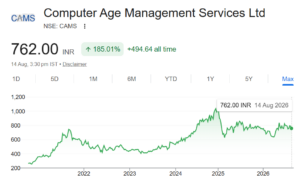
For the past 2 years the stock has moved only sideways creating base for next level movement.
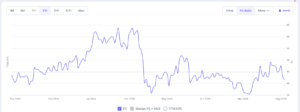
PE ratio has also reverted to MEDIAN
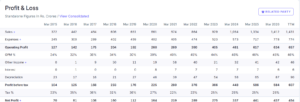
Valuation & Margin of Safety: Quality vs. Price
A great business does not automatically make a great investment if the price paid negates future returns.
[ Valuation vs. Operational Moat Spectrum ]

 Low / Thin                                                   High / Wide
 ─────────────────────────────────────────────────────────────────────────
 Valuation Margin of Safety : [██████░░░░░░░░░░░░░░] ~38x P/E (Priced for Growth)
 Operational Moat           : [████████████████████] 68% Market Share & Zero Debt
 Capital Efficiency         : [████████████████████] ~40% ROE & 45%+ EBITDA Margins
 ─────────────────────────────────────────────────────────────────────────
Investing in CAMS is not a bargain-basement value play. The operational margin of safety is exceptionally wide due to its entrenched market position and debt-free balance sheet. However, the valuation margin of safety remains thin at ~38x P/E, which raises am important question in valuation? Should you pay a premium to buy a growing business with a strong moat? Or do you find comfort in buying business backed by physical assets? Answer to this question will decide the BUY/SELL decision.